
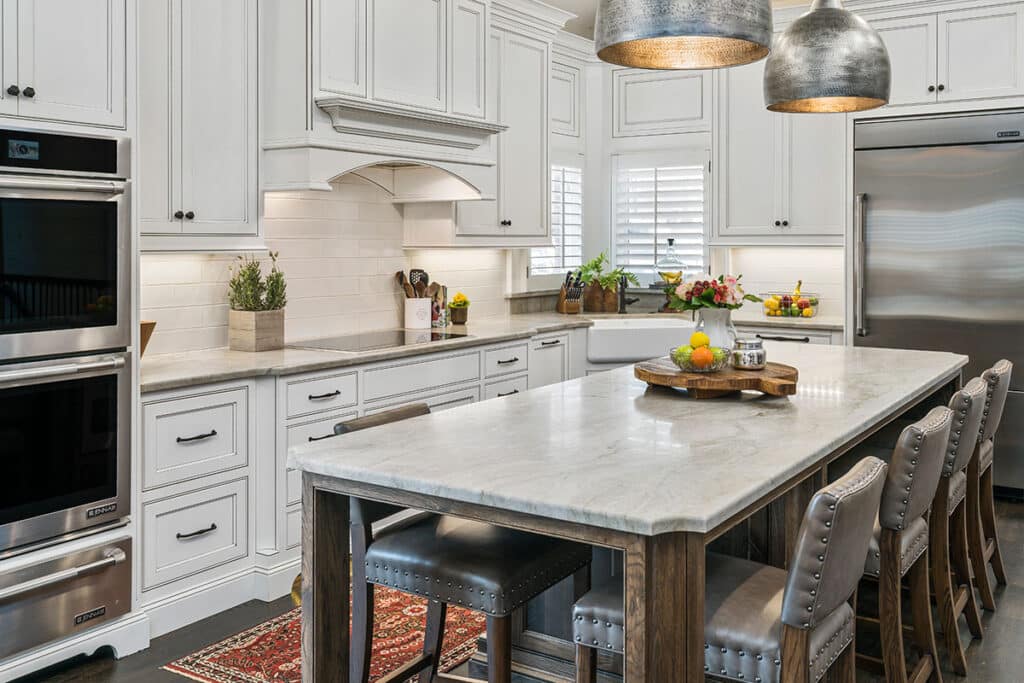
Quartzite is one of the harder natural stones we work with, and its thickness plays a big role in how a project looks and holds up. Knowing your options ahead of time makes the whole process easier.
We help homeowners, designers, and builders across Solon, Cleveland, and Northeast Ohio choose the right slab for every job. Here is how quartzite thickness works, and how to pick the right one for your space.
The Two Standard Thicknesses
Most quartzite slabs come in two thicknesses: 2 centimeters and 3 centimeters. In inches, that is roughly three-quarters of an inch and one and a quarter inches.
The 3 cm slab is the most common choice for kitchen counters and islands. It is thick enough to install without a plywood support underneath, and it reads solid and substantial.
The 2 cm slab is thinner and lighter, often used for vanities, backsplashes, and commercial work.
Pro tip: For a standard kitchen counter, 3 cm is usually the better call. It resists cracking during handling and gives you a stronger edge.
Countertops and Islands
For kitchens, 3 cm quartzite is the go-to. The extra thickness stands up to daily use, supports long spans, and works well on an island where the edge is on full display.
If you want a heavier, more dramatic look, we can build up the edge to make the stone appear even thicker.
Pro tip: A built-up or mitered edge can make a 3 cm slab look 4 cm or thicker. It is a smart way to get a bold island profile without the weight of a solid thick slab.
Vanities and Bathrooms
Bathroom vanities give you more flexibility. Both 2 cm and 3 cm quartzite work well, since a vanity does not carry the same load or span as a kitchen counter.
A 2 cm top can keep costs down and pairs nicely with a lighter, more refined look.
Pro tip: If you want your bathroom and kitchen to match, use the same thickness in both. Consistency across rooms makes a home feel put together.
Your One-Stop Shop For Anything Countertop-Related
How Thick Is Quartzite, and Which Thickness Do You Need?
The right thickness depends on the project and the look you want, from a standard counter to a bold island edge. Our Northeast Ohio team helps you pick the size that fits your design and budget.
Custom and Commercial Projects
For feature walls, waterfall edges, fireplace surrounds, and commercial spaces, thickness depends on the design. Waterfall islands often use 3 cm for a continuous, solid look down the sides.
Thinner 2 cm stone can work for wall cladding and vertical applications where weight matters.
Pro tip: For any custom project, talk through the design with your fabricator early. The right thickness depends on span, support, and the look you are after, and we can guide that call.
How Thickness Affects Price and Install
Thicker slabs use more material, so 3 cm generally costs more than 2 cm. It also weighs more, which affects handling and the support your cabinets need.
That said, 3 cm often installs without added plywood backing, which can simplify the job.
Pro tip: Browse our inventory to see thickness listed with each slab, and ask about remnants for smaller projects where a partial piece will do.
Choosing the Right Thickness for Your Project
Match the thickness to the job. For most kitchens and islands, 3 cm gives you strength and a solid look. For vanities and lighter uses, 2 cm can save money without giving up quality.
When in doubt, think about span, weight, and the edge profile you want, then let the design lead.
Pro tip: See full slabs in person before deciding. Thickness reads differently in a showroom than on a sample, and the edge is easier to picture with the real stone in front of you.
Ready to Find the Right Quartzite for Your Project?
The right thickness comes down to how you will use the stone and the look you are going for. That is exactly the kind of detail we help our clients sort out.
Visit us in Solon to see full quartzite slabs in person and talk through your project with our team. Contact Granex or get a free estimate today, and let’s build something that fits perfectly.