
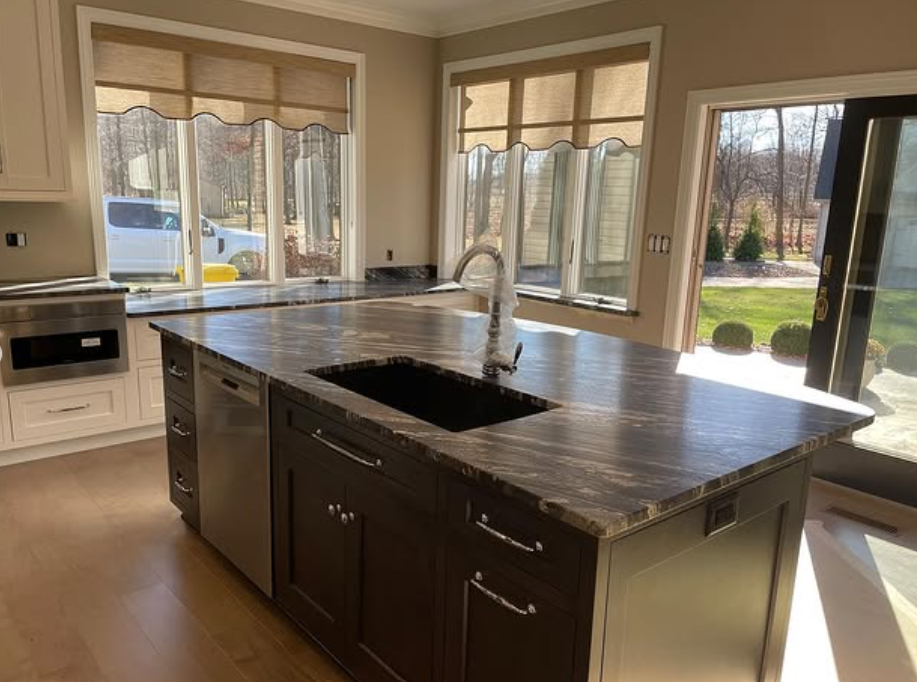
Countertops are the one upgrade nearly every kitchen remodel includes. The 2026 U.S. Houzz Kitchen Trends Study found that 91% of renovating homeowners upgrade their countertops. Once you pick granite, one of the first technical questions is thickness, and it affects more than looks.
Stone suppliers such as Arizona Tile list 2 cm and 3 cm as the standard countertop thicknesses. Here is what that means for homeowners, designers, and builders across Solon, Cleveland, and Northeast Ohio.
How Thick Is a Granite Slab, in Plain Numbers
A 2 cm granite slab is roughly 3/4 inch thick. A 3 cm slab is roughly 1 1/4 inches thick. Those are nominal measurements, so a slab can run a hair over or under depending on how it was cut and polished at the quarry.
Thinner material exists for wall cladding and some furniture, and thicker looks are possible through edge work. For kitchen and bath countertops, though, nearly every decision comes down to 2 cm or 3 cm.
3 cm Granite: Why It Is Common in Kitchens
A 3 cm slab is heavy and rigid enough to sit directly on well-built cabinets without a plywood sub-top in most layouts. It also gives a fabricator more material to shape, which matters for profiles like ogee and full bullnose.
The added thickness also reads well visually on standard-height base cabinets. It looks substantial without needing extra build-up.
Pro Tip: If you are planning an undermount sink, ask how the fabricator reinforces the narrow strips of stone in front of and behind the sink. That is where granite is most likely to crack during transport or installation, regardless of thickness, and a good shop plans for it before cutting.
Your One-Stop Shop For Anything Countertop-Related
Asking How Thick Is a Granite Slab for Your Kitchen? Ask the Granex Team.
Granite slabs usually come in 2 cm or 3 cm. Learn what each thickness means for support, edges, sinks, and cost, from the fabrication team at Granex in Solon, Ohio.
2 cm Granite: Where It Makes Sense
A 2 cm slab weighs less and can cost less in material. It is a common choice for bathroom vanities, backsplashes, and some modern designs that call for a slimmer profile.
On kitchen cabinets, 2 cm granite usually needs a plywood sub-top for support. Many fabricators also laminate a strip along the front edge so the counter looks thicker from the side. Done well, that seam disappears. Done poorly, it shows as a line along every edge.
Pro Tip: Look at the laminated edge on a finished 2 cm sample before you commit. Lighter granites with busy patterns hide the joint better than dark, solid colors.
Other Factors That Ride on Granite Thickness
Thickness affects overhangs, cabinet strength, and appliance fit. A bar-height or seating overhang may need brackets or hidden supports, and the right answer depends on the stone, the overhang depth, and the cabinet layout.
Cabinets also need to be level and solid before stone goes on. Granite will not flex to hide an uneven base, and a twist in the cabinets can show up as a gap at the backsplash or a stressed seam.
Pro Tip: If you are replacing countertops on existing cabinets, have the cabinets checked for level and secure attachment at templating. Fixing that before the stone arrives is far easier than after.
Want to learn more about the materials themselves? Our Know Your Stones guide covers the differences between granite, quartzite, marble, and more.
See Granite Thickness in Person at Granex
Since 2006, Granex has fabricated and installed custom stone for homes and commercial projects across Ohio. We are a proud member of the Natural Stone Institute, and our team can show you how 2 cm and 3 cm granite look and perform before you choose.
Browse our granite countertops, check current slab inventory, or look through remnants for smaller projects like vanities.
Ready to talk about your project? Request a free estimate or call us at (440) 248-4915. We will help you pick the right granite and the right thickness for your space.